
The benefits of chemical-free office cleaning include using fewer cleaning products routinely, less packaging and storage, and a cleaning process that is less intrusive in occupied spaces. Although, the method still needs to be suitable for the surface, the type of dirt and the level of hygiene required.
What Does Chemical-Free Cleaning Mean?
In commercial cleaning, chemical-free usually refers to methods that reduce or replace conventional cleaning chemicals, such as purified water, steam, microfibre systems or aqueous ozone.
However, washrooms, kitchens, spillages, heavy grease, limescale and infection-control situations may still require task-specific detergents, descalers, degreasers or disinfectants.
Chemical-free methods commonly used in workplaces include:
| Cleaning Method | Where It May Be Used |
|---|---|
| Stabilised aqueous ozone | Routine hard-surface and workplace cleaning |
| Microfibre and water | Dust, light marks and general surface cleaning |
| Steam cleaning | Detail cleaning on suitable heat-resistant surfaces |
| Purified water | Internal or external glazing |
| Mechanical floor cleaning | Floors with light or moderate soil |
| Sustainable cleaning products | Tasks where a cleaning agent is still needed |
At some of our sites, stabilised aqueous ozone is used to reduce reliance on conventional cleaning chemicals. This aligns with our wider approach to innovation, which includes sustainable procurement, probiotic products and investment in cleaning technology.
What Are The Main Benefits For Corporate Workplaces?
Chemical-free methods support environmental and operational goals when they are introduced for the right tasks.
The benefits depend on how the system is implemented. Replacing a product is most useful when the alternative doesn’t cause extra labour, water use, repeat cleaning or surface damage.
Reduced Routine Contact With Harsh Ingredients
Reducing the number of products used each day can limit opportunities for operatives and employees to come into contact with harsh cleaning ingredients.
The HSE notes that some cleaning-product ingredients can cause skin allergies or asthma, while corrosive products can cause skin burns and eye damage. It also recommends work techniques that minimise contact, together with suitable storage, ventilation and protective equipment where required.
Risks can still remain. Repeated wet work can also contribute to dermatitis, so training and safe methods are always important.
Less Packaging, Dosing And Storage
An on-site generation or refill system can reduce the number of bottles, concentrates and packaged products required for routine cleaning tasks.
This simplifies storage and reduces the chance of incorrect dilution. Product consumption typically becomes easier to monitor across large corporate buildings or multi-site portfolios.
Environmental performance should still be assessed across the full cleaning process. The EU Ecolabel criteria for professional cleaning consider hazardous substances, raw materials, packaging, product guidance, water and energy use, and waste management covering the wider lifecycle of cleaning services.
Cleaning In Occupied Offices
Where conventional sprays are replaced with methods that leave less visible residue or odour, cleaning may be less disruptive in occupied areas. This can be particularly useful in meeting rooms, receptions, shared workspaces and other areas where cleaning must be carried out discreetly.
Methods such as prepared microfibre cloths, aqueous ozone and mechanical cleaning can also reduce the number of products and containers moved through the workplace.
Achieving Sustainability Goals Beyond Cleaning
Cleaning is a recurring service, so even small sustainability actions can become significant when repeated across floors, buildings and portfolios.
A low-impact cleaning service can contribute to sustainability reporting through measures such as:
- Volume of chemical products avoided
- Packaging purchased, reused or removed
- Concentrate and refill consumption
- Water and energy used by cleaning equipment
- Staff training completion and method compliance
These measures give facilities teams and tenants more useful information than a broad claim that a service is “green”.
Why “Eco-Friendly” Claims Need Evidence
Terms such as “chemical-free”, “natural” and “eco-friendly” workplace cleaning can be too broad.
The Competition and Markets Authority’s Green Claims Code says environmental claims should be accurate and properly supported. The CMA also cites an international review which found that 40% of online green claims could be misleading.
Facilities managers need to ask what a claim means in practice:
- Which traditional products have been removed or reduced?
- Which tasks still require a cleaning agent?
- Has the alternative been tested on the relevant surfaces?
- Does it reduce packaging, water, energy or transport?
- How is performance measured?
- Is there independent product certification or technical evidence?
This helps separate measurable improvement from vague language.
Why Workplace Expectations Matter
Sustainability decisions can influence how employees and other stakeholders view an organisation.
Deloitte’s 2024 UK survey found that 90% of Gen Z and millennial respondents considered working for an organisation that shared their values and ethics important to workplace satisfaction and wellbeing. The same survey found that 62% of Gen Z respondents and 60% of millennials had pressured their employer to take climate action.
This explains why there is increasing expectation on suppliers to provide evidence of environmental action and how it is a strong consideration especially for future generations.
Where Chemical-Free Office Cleaning Works Best
Chemical-free office cleaning works best on routine tasks where the surface, and expected result are predictable.
Suitable tasks can include:
- Routine cleaning of desks and hard surfaces
- Internal glass and mirrors
- General dust and light marks
- Floor cleaning supported by mechanical action
- External glazing cleaned with purified water
- Frequent touchpoint cleaning where the method has been assessed
- Selected reception, meeting room and communal areas
These suit chemical-free cleaning because the cleaning requirement is standard. For example, a desk, meeting table or internal glazing is more likely to need dust and light marks removed. The surface can then be checked for quality, streaking and image before the method is introduced more widely.
Using Chemical-Free Systems On-Site
At selected corporate sites, we use the Tersano lotus PRO to make an aqueous ozone solution, built into the cleaning cupboard.
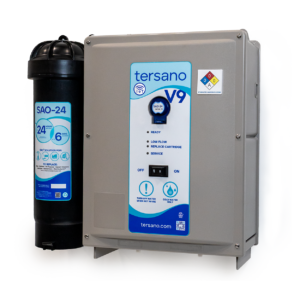
The unit connects to the cold-water supply and produces the solution. Operatives are then able to fill reusable spray bottles, mop buckets and compatible cleaning equipment from one central point.
We use it as part of our mixed cleaning approach, alongside microfibre systems, sustainable cleaning products and task-specific chemistry where needed. This allows suitable routine tasks to be completed with less reliance on packaged cleaning products and harsher ingredients.
Where Specialist Cleaning Products Are Still Needed
Some tasks still require a detergent, degreaser, descaler or disinfectant because the issue being cleaned is more complex.
Manufacturer instructions will state which products can or cannot be used on a surface. This is especially important for treated floors, specialist coatings, natural stone, electronic equipment, washroom fittings and food preparation areas.
A cleaning specification should make these exceptions clear:
| Question | Why It Matters |
|---|---|
| What is being removed? | Dust, grease, scale and biological contamination need different methods |
| What is the surface? | Heat, moisture, acidity or abrasion can damage some materials |
| What hygiene outcome is required? | Routine presentation cleaning differs from disinfection |
| Is the method suitable for regular use? | A method may work once but still be unsuitable for daily cleaning if it affects the surface over time |
| When is a specialist product required? | Operatives need clear instructions on when chemical-free methods are not enough |
| How will results be checked? | Audits, feedback and rework data show whether the method is effective |
This is why chemical-free office cleaning should be introduced as part of a planned cleaning programme. The strongest approach is to use lower-impact methods where they work well, while keeping task-specific products available where the surface, soil or hygiene requirement calls for them.
HSE guidance explains that controls should reflect the task and the substance involved. This supports a planned approach rather than applying one cleaning method to every area.
Get In Touch
If you are reviewing your workplace cleaning programme, we can help assess where lower-impact methods may be suitable.
Our teams support corporate workplaces with cleaning programmes built around the building, its users and the required standard.
Get in touch to discuss chemical-free cleaning, sustainable product selection or wider commercial cleaning support.