
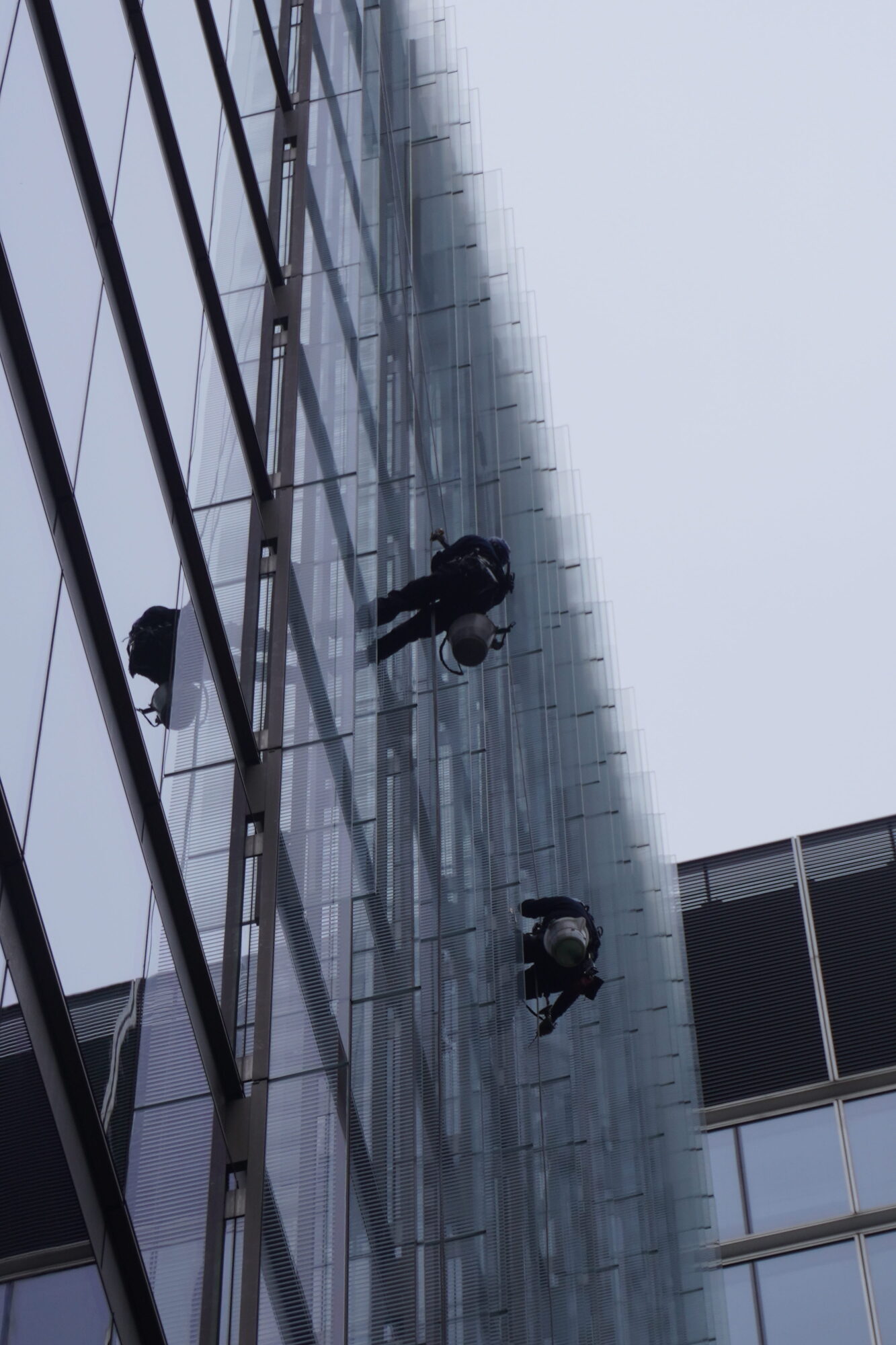
It is often the fastest, least disruptive option for buildings without a BMU or with complex façades. This guide covers when to use it, its limits and what building owners need in place first.
What Is Rope Access Window Cleaning?
Rope access is a method of working at height where technicians are suspended from secure anchor points on the roof. Each technician uses two independent ropes: a working line and a backup safety line. If one fails, the other holds.
In the UK, most commercial rope access work follows the system set by the Industrial Rope Access Trade Association (IRATA). Technicians are qualified at three levels, and every team is supervised by an experienced Level 3 technician.
When Is Rope Access The Best Option?
Rope access usually makes sense when:
- There is no BMU, or the BMU cannot reach every elevation.
- The façade is complex, with curves, fins, recesses, atria or overhangs.
- Ground access is limited, so MEWPs cannot be positioned safely or would block roads and entrances.
- The building is too tall for water-fed poles, which generally work best up to around three storeys.
- Disruption must be kept low. Rope teams need a small footprint and can set up quickly, with no scaffolding.
- Other work is needed at the same time, such as cleaning signage, cladding or gutters, or a quick visual check of the façade.
What Are The Limits Of Rope Access?
Rope access is flexible, but it is not right for every building:
- Weather: work stops in high winds, heavy rain or lightning. Programmes need some flexibility, particularly in autumn and winter.
- Anchors: the building needs suitable, certified anchor points, or a safe way to install temporary ones.
- Ground area: an exclusion zone below the drop is needed to protect people from falling tools or water.
- Very large façades: a well-maintained BMU can be quicker for regular cleaning of very large, flat glazed elevations.
The Work at Height Regulations 2005 require the access method to be chosen through risk assessment. A good contractor will explain why rope access is the right method for each elevation of your building.
What Building Owners Need In Place
HSE guidance is clear that safety at height is shared between the building owner, the contractor and the operatives. Before rope access work begins, the person in control of the building should be able to provide:
- Certified anchor points. Permanent roof anchors, davits and tracks are typically inspected and certified at least every 12 months. Keep the latest certificate on file.
- Roof access arrangements. Safe routes to the roof, keys, permits and any restrictions.
- Site-specific information. Plans showing anchor locations, fragile surfaces, plant and hazards.
- An emergency and rescue plan. The contractor will bring its own rescue plan, but it must work with your site procedures.
- Ground-level coordination. Agreed exclusion zones, signage and timings around entrances, deliveries and events.
What To Expect From Your Rope Access Contractor
Ask any rope access window cleaning provider for:
- IRATA-qualified technicians, with a Level 3 supervisor on every job
- A site-specific risk assessment and method statement (RAMS)
- A written rescue plan and rescue-trained team members
- Evidence of equipment inspection and suitable insurance
- Tool lanyards and drop-prevention measures to protect people below
- Clear communication with your site team before, during and after each visit
How Often Should High-Level Windows Be Cleaned Using Rope Access?
Most commercial buildings book external high-level cleaning every six to twelve months. City-centre sites, busy main roads and prestige façades often need more frequent cleaning because of traffic pollution and visibility.
Many buildings combine methods: rope access for complex elevations, a BMU for large flat façades and water-fed poles for lower floors. Planning these together keeps cost and disruption down.
Rope Access Window Cleaning With DOC Cleaning
DOC Cleaning’s specialist high-level teams deliver rope access, BMU, MEWP and water-fed pole window cleaning for commercial buildings and landmark properties. Our in-house Vertical Division is a Probationary Member of IRATA International and is working towards full membership. Before work starts, we use 3D mapping and site-specific planning to understand each building’s geometry and access routes. The same teams deliver BMU cradle window cleaning at 100 Fetter Lane and planned high-rise cleaning at The Octagon, Birmingham.
To discuss your building, visit our rope access window cleaning page or get in touch to arrange a survey.
Rope Access Window Cleaning: FAQs
Is rope access window cleaning safe? Yes, when carried out by qualified technicians following the IRATA system. Twin ropes, supervision and rescue planning keep risk low.
Is rope access cheaper than a BMU or MEWP? Often, for complex or occasional work, because there is no equipment hire and set-up is quick. For large, flat façades cleaned frequently, a BMU can be more efficient.
Does rope access disrupt building users? Very little. Technicians work from the roof, and only a small exclusion zone is needed at ground level.
What happens if the anchor points are out of date? Work should not go ahead until the anchors are inspected and certified. Check your certificate dates well before booking.
Can rope access be used for more than windows? Yes. It is also used for cladding and signage cleaning, gutter clearance and façade inspections.