
Both methods have a place in a well-planned cleaning programme. This guide explains how each one works and where it delivers the best results.
What Is Water-Fed Pole Window Cleaning?
A water-fed pole system uses a telescopic pole fitted with a soft brush head. Purified water travels up the pole and rinses the glass as the brush loosens dirt and grime.
The water is treated to remove almost all dissolved minerals, typically down to 0 to 10 parts per million. According to the Federation of Window Cleaners, modern poles can reach windows up to around 24 metres high, letting operatives work safely from ground level. Because the water carries no minerals, glass dries naturally without spotting or streaking.
Keeping the system effective takes some upkeep. Operatives monitor water purity with a TDS meter and replace filters as they wear, since a rise in dissolved solids is usually the first sign a resin change is due. Poles also need regular inspection, since worn clamps or sections can affect both results and safety on site.
What Is Traditional Squeegee Window Cleaning?
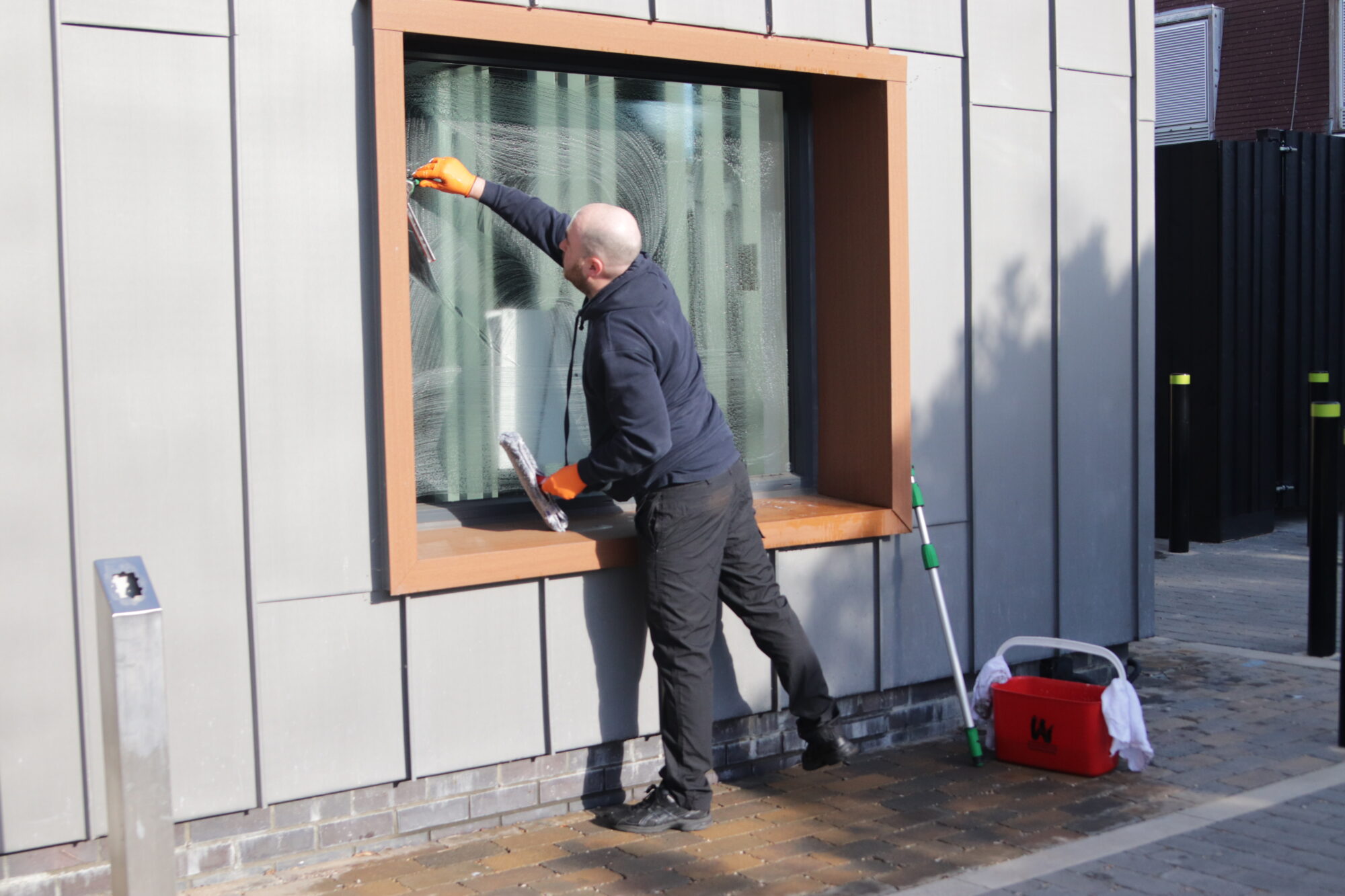
Traditional cleaning uses a detergent solution, a scrubber or washer sleeve, and a squeegee. The operative applies the solution, agitates the surface to lift dirt, then removes it in smooth overlapping strokes before finishing with a lint-free cloth.
This method suits windows that need direct attention, such as frames, sills, tracks and areas with stubborn contamination.
Comparing the Two Methods
The table below summarises how the methods differ in practice.
| Factor | Water-Fed Pole | Traditional Squeegee |
|---|---|---|
| Typical reach | Ground level up to roughly 24m (with modern poles) | Limited to arm’s reach or ladder access |
| Access needed | Vehicle or trolley-mounted water system | Bucket, solution and squeegee kit |
| Finish | Streak-free without detergent | Detailed, controlled finish including frames |
| Best suited to | Large glazed elevations, regular programmes | Interior glazing, retail frontages, heritage glazing |
| Environmental impact | No detergent, less chemical use | Requires cleaning solution |
When Water-Fed Pole Cleaning Works Best
Water-fed poles suit buildings where large areas of exterior glazing need cleaning on a regular schedule.
- Mid-rise buildings with several storeys of continuous glazing
- Sites where reducing work at height lowers risk, in line with the Work at Height Regulations 2005
- Buildings with frequent cleaning cycles, where speed across large areas matters
- Organisations prioritising a lower-chemical, more sustainable cleaning approach
When Traditional Squeegee Cleaning Is the Better Choice
Some situations call for the control and finish that only hands-on cleaning provides.
- Interior glazing and partitions, where run-off cannot be rinsed away
- Retail frontages, where an attended, immediate finish supports presentation
- Heritage or leaded glazing, where a gentler, controlled touch protects delicate frames
- Ground-floor or low-level windows with heavy contamination such as adhesive residue or bird fouling
Why Many Facilities Teams Use Both Methods Together
In practice, the best results often come from combining the two. Water-fed poles handle the main glazed elevations efficiently, while squeegee work covers frames, interiors and any areas that need closer attention.
This approach lets a cleaning programme adapt to a building’s design rather than forcing one method to do every job. Operatives trained through the British Window Cleaning Academy are trained in both techniques, which supports this flexibility on site.
A mixed-use building is a good example. Upper-floor office glazing can be run efficiently with a water-fed pole on a scheduled cycle, while the ground-floor retail frontage gets a squeegee finish so it looks immaculate the moment shoppers walk past. Treating the two areas differently, rather than applying one method across the whole building, usually gives a better result for less cost.
For buildings taller than a pole can reach, other access methods take over. Our related guide on the safest methods for high-rise window cleaning covers rope access, MEWPs and BMU cradles in more detail.
Questions to Ask a Window Cleaning Contractor
Before agreeing a schedule, it is worth checking how a contractor will approach your building.
- Do they offer both water-fed pole and traditional squeegee cleaning, or only one?
- How do they decide which method to use on different parts of the building?
- What training do their operatives hold, and how do they monitor water purity on site?
- How do they manage access near overhead power lines or other site-specific hazards?
A contractor who can answer these clearly is more likely to plan a programme around your building rather than a standard one-size-fits-all visit.
Talk to Us About the Right Method for Your Building
Every building has a different mix of glazing, access and presentation needs. We plan window cleaning programmes around the specific site, combining water-fed pole and traditional methods where it makes sense rather than defaulting to one approach.
Get in Touch
If you would like advice on the right window cleaning method for your building, get in touch with our team.