
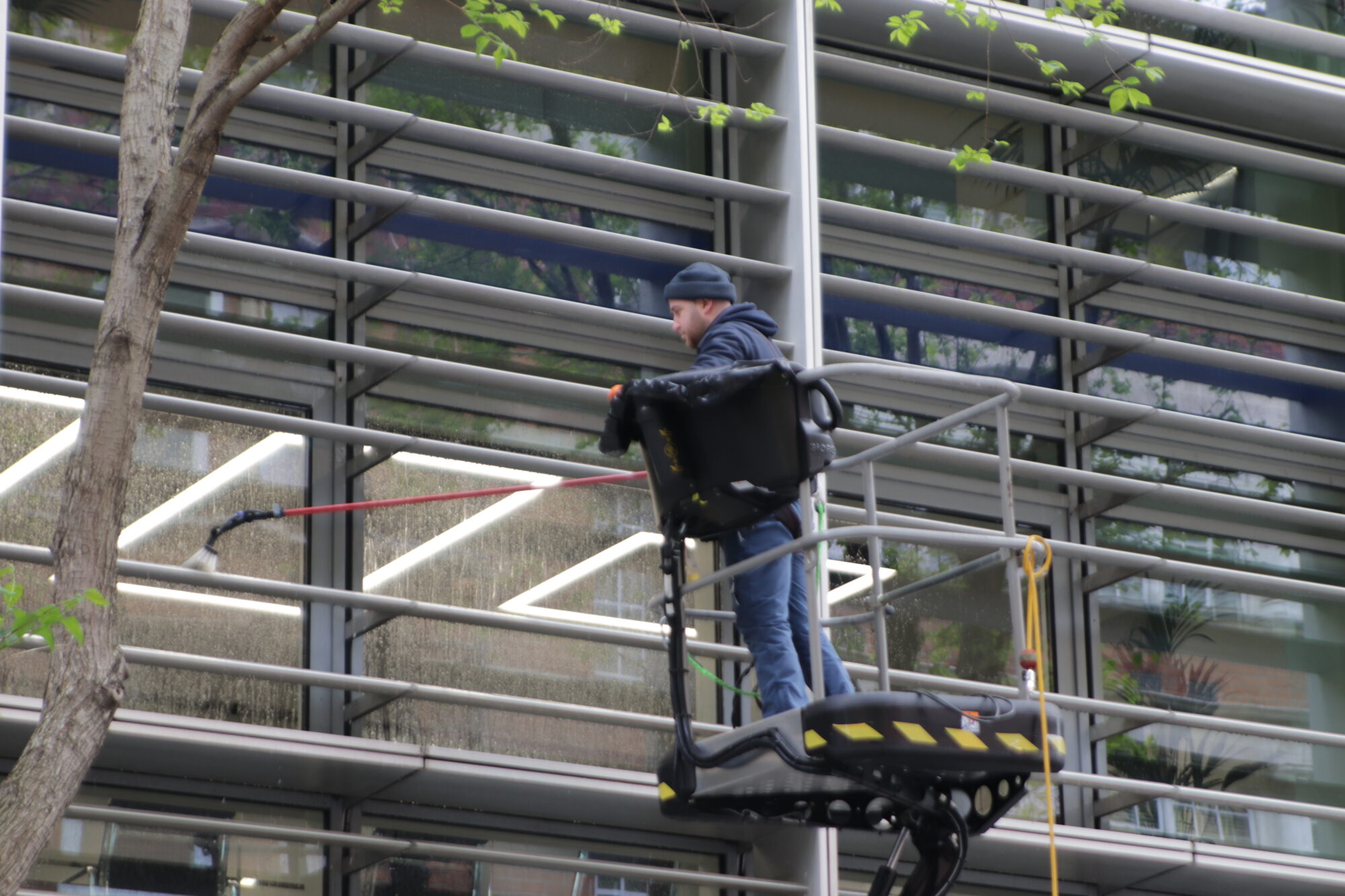
Pollution can leave visible staining on glass, stone, cladding, brickwork and building features. Over time, the building exterior will become poorly maintained, even if the interior is well managed.
For facilities managers and property teams, commercial façade cleaning services can help protect presentation standards and support planned exterior maintenance.
Central London buildings are exposed to heavy pollution
Central London has a mix of road traffic, construction work, commercial buildings, public transport, hospitality, retail and pedestrian movement. This creates a challenging environment for building exteriors.
Central London buildings are exposed to pollutants in the air, including nitrogen dioxide and from traffic and construction work. According to The City of London research, the City of London is designated as an Air Quality Management Area for nitrogen dioxide and PM10, which highlights the ongoing impact of pollution in commercial areas.
While London’s air quality has improved in recent years, pollution is still an important part of commercial façade maintenance. City Hall reporting shows reductions in emissions since 2016, but pollutants such as nitrogen dioxide and fine particles are being closely tracked. These particles can settle on glass, stone, cladding and other external surfaces, contributing to staining over time.
How pollution affects commercial façades
Pollution can build up gradually across a building exterior. In busy urban locations, the clearest signs appear around lower elevations, entrance areas, ledges, window frames, signage, stone detailing and areas close to roads.
Common effects include:
- Dark staining
- Traffic film
- Dust deposits
- Streaking
- Discolouration
- Patchy soiling after rainfall
Some materials show this more quickly than others. Light stone, glass, metal cladding and rendered surfaces can all lose visual clarity when pollution deposits are left untreated.
We consider the surface type, location, access requirements and level of staining before recommending a cleaning method as standard approaches aren’t suitable for every façade material.
Why staining is often uneven
Pollution staining rarely appears evenly across a façade.
Rainwater movement, wind direction, building detailing and sheltered areas all affect how dirt settles. Ledges, recesses, decorative stonework, signage zones and areas beneath overhangs often collect more soiling because water and airborne particles can become trapped.
On taller buildings, staining may vary between elevations. A façade facing a busy road may show heavier traffic-related deposits, while a sheltered side may develop streaking or staining where water runs over the surface.
This is why pollution stain removal services is planned around the specific building rather than the appearance of one elevation alone.
The effect on glass, stone, cladding and brickwork
Different façade materials respond to pollution in different ways.
| Façade material | Common pollution-related issues |
|---|---|
| Glass | Traffic film, water marks, smears and reduced clarity |
| Natural stone | Dark staining, soiling in pores and discolouration around details |
| Metal cladding | Dust deposits, streaking and dull surface appearance |
| Brickwork | Dirt build-up in textured areas and staining near ledges or run-off points |
| Rendered surfaces | Patchy soiling, algae growth in damp areas and visible discolouration |
| Signage and building features | Localised dirt build-up and less clear impact |
The aim is to clean the surface safely, improve the building’s appearance and avoid methods that could damage sensitive materials.
Why façade cleaning supports workplace and brand presentation
A commercial building exterior contributes to the way people perceive the organisation inside it.
For offices, retail properties and mixed-use developments, stained or poorly maintained façades affect first impressions before anyone enters the building. Clean glass, well-maintained entrances and cared-for exterior support workplace presentation and tenant confidence.
This is particularly important in central London, where commercial buildings often sit in busy locations with heavy footfall and strong visibility. A planned cleaning programme helps maintain the professional appearance of the building throughout the year.

Planning commercial façade cleaning services
Commercial façade cleaning services begin with a site assessment.
Considering the façade material, height, access limits, surrounding public areas, cleaning history and the type of staining present. Also accounting for opening hours, tenant needs, pedestrian management and nearby roads or public spaces.
Planned façade cleaning can involve water fed pole cleaning, rope access, MEWP access, BMU operations or specialist surface cleaning depending on the site. For sensitive materials, test patches may be appropriate before cleaning begins.
Historic England’s technical guidance highlights the importance of informed maintenance and suitable treatment for historic buildings and traditional materials. While not every central London commercial property is historic, the same principle applies: cleaning methods should be suitable for the surface and the level of soiling.
Reducing long-term maintenance issues
Heavy soiling can hide defects, staining can become harder to remove and façade details require more intensive cleaning if routine maintenance is delayed. Regular cleaning can help property teams identify issues such as damaged sealant, blocked drainage points, staining patterns, surface deterioration or areas affected by water run-off.
The National Centre for Atmospheric Science describes black carbon as soot from combustion and a component of PM2.5, with research in central London showing that sources extend beyond road traffic. For property teams, it explains why façade soiling can remain a recurring maintenance issue even as vehicle-related pollution improves.
Choosing the right building exterior cleaning company
Choosing the right provider is important because façade cleaning involves access, safety, surface compatibility and reducing disruptions.
The cleaning team should be able to assess the building, explain the recommended method and plan the work around the site’s operational needs. For central London locations, this may include pedestrian routes, loading restrictions, landlord requirements, public highways, tenant communication and out of hours working.
We are also able to advise on cleaning frequency. Buildings near busy roads, construction areas, transport hubs or exposed junctions may need more frequent cleaning than sites in quieter locations.
Get in touch
If you are looking for a specialist partner to support your high-rise window cleaning requirements, we can help.
We provide rope access window cleaning, BMU cleaning, MEWP access cleaning and specialist façade maintenance for commercial buildings, corporate headquarters and mixed-use developments across the UK.
Contact us today to learn more about our high-rise window cleaning services.